Thai silk, a living material
A closer look at the fibre, light and living traditions that give Thai silk its singular presence.
Silk is never entirely still. Even before colour or pattern enters the picture, the cloth responds to light, movement and touch. Thai silk is especially expressive: quiet in shadow, luminous when it turns, and full of small variations that make a surface feel alive rather than flat.
A fibre that answers light
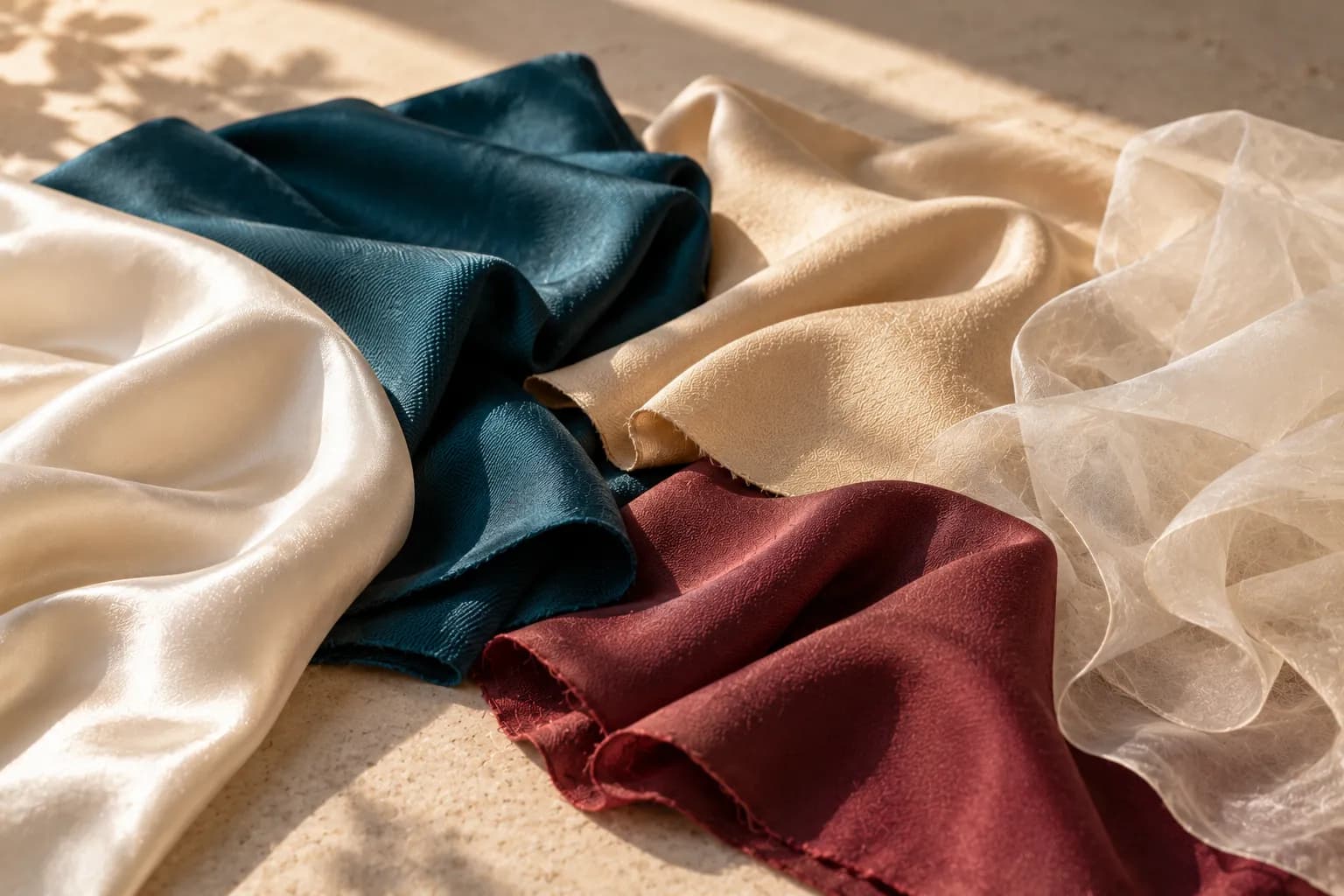
What we first notice in silk is often its lustre, but lustre is not the same as shine. A synthetic surface can look uniformly glossy. Silk behaves more subtly. Its long, fine filaments reflect light at changing angles, so a colour may appear deep in one fold and almost weightless in the next.
This movement gives plain silk as much visual interest as a printed cloth. Ivory can hold notes of cream, pearl and pale gold. Navy can shift from ink to midnight blue. The effect is not added decoration; it belongs to the relationship between fibre, weave and light.
Touch tells a parallel story. Silk can feel smooth without being slippery, light without seeming fragile, and crisp while still falling close to the body. Those apparent contradictions are part of its appeal. The material does not perform in only one way; it changes according to how it is woven, finished, folded and worn.
From cocoon to continuous thread
The story begins with sericulture: the cultivation of silkworms and the mulberry leaves that feed them. When the silkworm forms its cocoon, it produces a remarkably long filament held together by a natural gum called sericin. The cocoon is softened in warm water so the fine filament can be reeled and combined into a usable yarn.
That continuity distinguishes filament silk from shorter staple fibres. It helps create a cloth with clarity, strength and a characteristic response to light. Yet there is no single universal silk. The breed of silkworm, the way yarn is prepared, the weave and the finishing process all influence the final hand and appearance.
To understand silk only as a luxurious end product is to miss this transformation. It begins as something biological and delicate, then becomes a structured textile through many controlled stages. The finished scarf carries that duality: nature in the fibre, precision in the cloth.
Thai silk is a landscape of traditions
Thailand’s silk culture is not one style or one technique. Across regions and communities, colour, motif and method have developed in distinct ways. Mudmee, a form of weft ikat, builds pattern by binding and dyeing sections of yarn before weaving. Other traditions favour supplementary threads, checks, stripes or cloth whose beauty rests in colour and texture alone.
These textiles are more than a catalogue of techniques. They contain local knowledge about plants, dyes, climate, dress and ceremony. Weaving has often been connected to household and community life, with skills carried through observation and practice. Contemporary designers can admire this history only by recognising its specificity, rather than reducing it to a vague idea of the handmade.
The most respectful response is attention: naming a tradition accurately when it is referenced, distinguishing inspiration from origin, and allowing regional textile cultures to remain complex. Thai silk has global visibility, but its histories belong first to the people and places that formed them.
Heritage and modern manufacture
Traditional handweaving is an important part of Thai textile heritage. It is also not the method behind every silk object made today. Contemporary silk can be woven, printed and finished with modern equipment, allowing precision, consistency and different forms of creative expression.
Soie de Siam’s scarves are made using modern production methods; they are not handmade or handwoven. We believe this distinction should be clear. Celebrating the cultural history of Thai silk does not give a modern product the right to borrow a craft claim it has not earned.
Modern manufacture does not make the material less worthy of attention. Quality can be considered through the choice of cloth, the balance and clarity of colour, the finish of the edges, the scale of a composition and the way the scarf behaves in use. Honesty about production lets those real qualities speak for themselves.
Learning to look slowly
A silk scarf rewards a slower look. Hold it near a window and notice how the colour changes as the cloth turns. Let it fall from one hand and observe whether the folds feel fluid or architectural. Look closely at the weave, then step back to see how the entire square carries an image.
That attention can continue in daily care. Avoid pulling jewellery across the surface, keep perfume and direct heat away from the fibre, and store the scarf loosely folded in a dry place away from prolonged sunlight. When cleaning is needed, choose a gentle hand wash in cool or lukewarm water with a detergent suitable for silk.
The point is not to make silk feel precious in the sense of untouchable. It is to understand what makes it distinctive. Worn often and cared for thoughtfully, it gathers movement, memory and familiarity. Its beauty is not frozen at the moment of purchase; it lives in use.